Hello, I’m Ethan Cole — a digital media analyst specializing in the culture of online streaming and the business behind internet personalities. Over the years, I’ve studied how creators turn attention — whether born from talent, controversy, or outright scandal — into sustainable revenue streams.
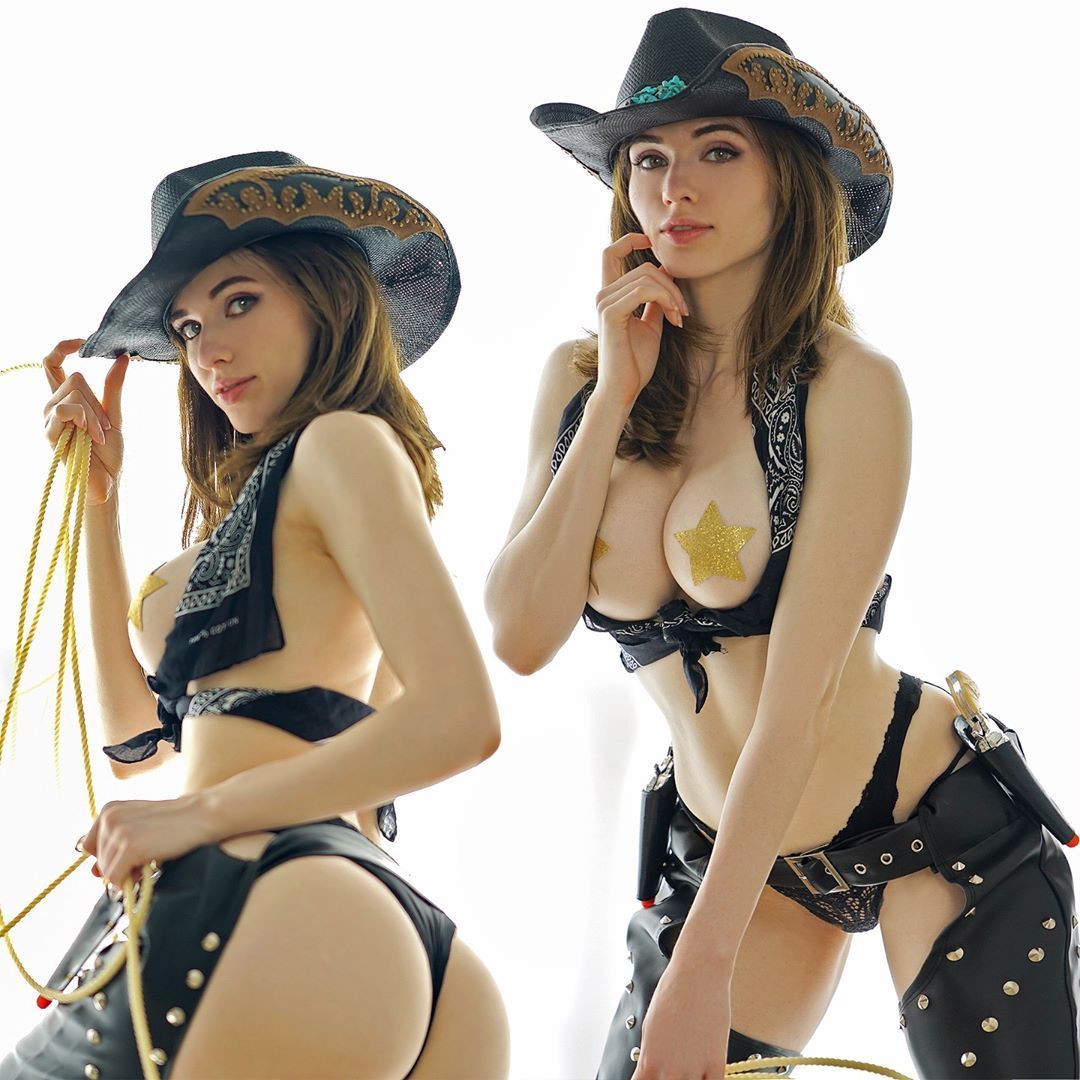
And few embody that transformation better than Amouranth. She’s not just a Twitch streamer; she’s a provocateur, a master of personal branding, and a million-dollar business wrapped in controversy.
From “Hot Tub” streams that shook Twitch’s moderation policies to OnlyFans earnings that outshine the paychecks of mainstream celebrities, Kaitlyn Siragusa has built her empire on the thin, dangerous line between entertainment and scandal. In this article, I’ll unpack how she leveraged controversy, erotic content, and sharp business moves to become one of the most talked-about figures in modern streaming.
Who Is Amouranth, Really?
Amouranth: Real Name, Early Years, and Online Start — From Cosplay to First Streams
Her real name is Kaitlyn Michelle Siragusa. She was born on December 2, 1993, in Houston, Texas. Before streaming, she built a reputation as a self-taught costume designer around 2010, working in local theater costuming and refining the skills that later shaped her on-camera persona. Cosplay was the gateway: she documented builds, character looks, and behind-the-scenes fabrication, steadily converting convention attention into a loyal online following.
The pivot to livestreaming came in 2016. What began as broadcasting cosplay work sessions evolved into longer, personality-driven streams. The move formalized the shift from “maker” to performer-brand: consistent camera time, parasocial engagement, and format experiments that would later define her breakout on Twitch.
Breakout on Twitch — Provocative Formats and Rapid Growth
I track her breakout to a clear pattern of format choices and timing:
- 2016–2019: Consistent cosplay/IRL and early Just Chatting blocks establish a personality-first channel. Occasional short suspensions only amplify visibility and push her further from pure gaming to talk-driven streams.
- 2020: Scale through long, high-frequency broadcasts (including late-night and “sleep” streams). The channel becomes an always-on funnel: chat interaction first, activities second.
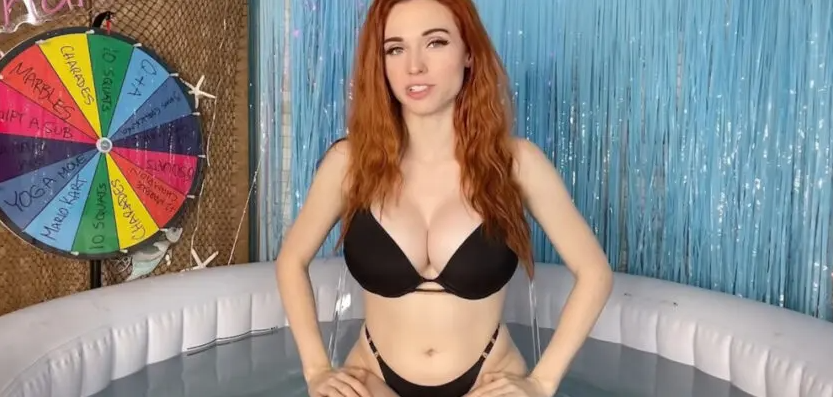
- 2021: The “Hot Tub” meta hits. She leans in, packaging pools, beachwear, and chat-led games into advertiser-bait headlines. Twitch’s creation of a dedicated category plus a brief ad freeze—and its later reversal—turn controversy into free press and a surge of followers.
- Mid-2021: ASMR/ear-licking sessions and yoga/fitness angles push the boundaries again. Short bans serve as PR spikes; returns from suspension are framed as “season premieres,” keeping retention high.
- Playbook: Minimal game focus, maximum parasocial engagement, relentless scheduling, and fast iteration on what sparks outrage or curiosity.
- Result: Rapid follower growth, dominant presence in Just Chatting, and a reputation as the format-setter other creators copy—while mainstream outlets cover each moderation clash like breaking news.
This wasn’t luck. It was a deliberate content engine: provoke → trigger moderation/press → return with a bigger audience → monetize downstream on paid platforms.
Amouranth: The Scandals That Made Her a Legend
The “Hot Tub” Era — Twitch’s Reaction, Bans, and Ad Pull
I watched the hot-tub meta explode in spring 2021, and the real inflection came in mid-May. On May 18, Twitch pulled ads from her channel as “not advertiser-friendly,” and she pegged the hit at roughly $35–40K a month. There was no prior notice. From my seat, that wasn’t just enforcement—it was a communications failure that multiplied the controversy.
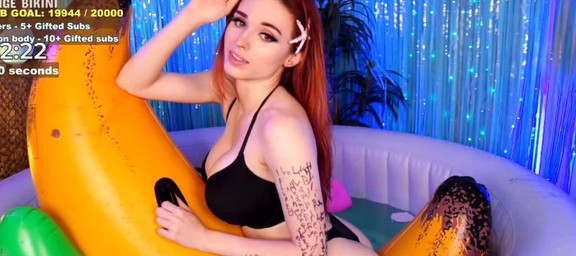
Three days later, Twitch introduced a separate Pools, Hot Tubs, and Beaches category and effectively restored ad delivery under tighter brand-safety controls. I read that as a classic platform compromise: legitimize the format, firewall the brands, and hope the noise dies down. It didn’t—because the noise was the product.
Through the summer, boundary-pushing ASMR and “ear-licking” sessions triggered short bans. Each suspension acted like a promo trailer: headlines, outrage, curiosity, return stream—repeat. She turned moderation cycles into a growth loop: provoke → get coverage → brief timeout → comeback spike → monetize downstream where the yields are higher.
My take is simple: none of this was accidental. It was a deliberate content engine built on timing, category arbitrage, and pressure-testing rules in public. Twitch’s slow, reactive policy shifts supplied the oxygen; she supplied the match.
Rule Violations and High-Profile Suspensions — My Shortlist
I keep this tight and chronological, with what mattered and why.
- Sep 2019 — wardrobe malfunction ban. I saw this as an inevitable enforcement moment that, paradoxically, spiked curiosity and reach.
- Mar 2020 — gym/IRL suspension (unclear wording). I flagged it as category risk: attire/filming rules in public spaces. Ambiguity fueled headlines more than the violation itself.
- May 2020 — brief suspension, reason unspecified. For me, this fit the pattern: edge-testing + opaque moderation = free press.
- May 18, 2021 — ad pull (not a ban). This was the most consequential hit: immediate revenue pain and a platform-wide brand-safety debate. Three days later, a new category solved Twitch’s dilemma—and she converted the noise into growth on paid channels.
- June 18–21, 2021 — ASMR/“ear-licking”/yoga ban. I read it as a meta crackdown. The return stream outperformed baseline—classic suspension-as-marketing spike.
- Oct 8–11, 2021 — simultaneous suspensions on Twitch/TikTok/Instagram. I treated this as a resilience test: cross-platform pressure, quick recovery, and proof the persona travels regardless of venue.
My takeaway is consistent: step to the edge, trigger enforcement, harvest attention, and re-route the heat into higher-yield funnels.
Staged or Real? Accusations of Manufactured Drama for PR
I treat “staged drama” claims as an audit problem: separate platform-policy friction from private-life events and check what survives basic verification.
First, the platform side. Her hot-tub/ASMR eras created predictable moderation loops: push a boundary, trigger enforcement, return to bigger numbers. That cycle looks engineered because it is—by design. It’s format arbitrage and timing, not necessarily fakery. The “drama” there is structural: when a creator lives at the edge of policy, every takedown becomes a headline and every return stream becomes an event.
Now, the personal side. In October 2022, she went live with allegations of marital control and coercion tied to content and finances. Follow-up streams and subsequent actions (regaining account access, public statements about safety, changes in business control) lined up with what I expect from a real crisis, not a staged one. Internet speculation flared, but I haven’t seen verifiable evidence that this was scripted.
Security incidents sit in a third bucket. In 2025, reports of a home invasion moved quickly from social posts to local news coverage and police involvement. That shift—from creator narrative to law-enforcement process—is the dividing line I use. Once an incident enters a formal investigation, “it’s all a bit” stops being a serious claim without hard proof.
Do creators sometimes amplify real events for narrative effect? Absolutely. I see framing, pacing, and selective disclosure—classic attention mechanics. But amplification isn’t fabrication. The question is whether there’s credible, falsifiable evidence of staging. Across the major flashpoints tied to her private life, I haven’t seen it.
My working model is simple:
- Platform drama: largely manufactured through calculated format choices and timing. It’s a growth lever, not a confession of fakery.
- Private-life disclosures: presumptively real unless disproven; in these cases, follow-on actions and third-party processes support authenticity.
- Security incidents: treat as real-world events when they enter official channels; skepticism without evidence is just conjecture.
Bottom line: she weaponizes controversy, but that doesn’t make every controversy fake. The staged element is in how and when stories are packaged—especially around policy edges—not in fabricating crimes or personal crises.
OnlyFans: A Money-Printing Machine
Why She Came to OnlyFans
Her move to OnlyFans wasn’t about chasing controversy — it was about platform mechanics and financial logic. By the time she made the switch, her audience was already conditioned for more exclusive content from her Patreon era, making the transition both seamless and lucrative.
Twitch, in her strategy, functioned more like a paid billboard, while OnlyFans became the checkout counter. The livestreams captured attention; the paywall converted it into revenue. This distinction proved crucial: while Twitch CPMs fluctuate with brand safety concerns, direct-to-fan monetization through OnlyFans allowed her to control pricing, packaging, and optimization.
The difference in earnings was dramatic. A strong month on Twitch might generate around $100,000, but on OnlyFans she could clear $1.5 million. At her peak posting cadence, monthly revenue consistently exceeded $1.5 million, with lifetime totals reaching into the tens of millions by mid-2022. That scale made it clear where the focus should be.
From 2020 onward, she built a small in-house team to streamline operations: daily posts, DM engagement, custom content requests, and themed seasonal bundles. This systemized approach drove higher output, and with it, significant growth. Eventually, she expanded into running an agency, packaging her content playbook as a service for others.
Twitch’s 2021 ad monetization issues and the industry-wide push toward brand safety only reinforced the decision. She increasingly prioritized a channel where payout terms were predictable and ownership over pricing, timing, and upsells rested entirely in her hands.
By 2024, she openly acknowledged a key reality: OnlyFans is not an ideal starting point without an existing audience. The model rewards those with scale and brand recognition — something she had already built through years of streaming and social media work. For her, the funnel was in place: Twitch and social media filled the top, and OnlyFans converted the traffic into paying subscribers.
The Numbers — Multi-Million Months and Pay-Per-View at Scale
I measure her business on outcomes, not vibes. The outcomes are blunt:
- Monthly ceiling: ~$1.5 million on OnlyFans in a strong month.
- Twitch vs OF: a typical Twitch month sits around $100,000, while OF clears ~$1.5M when the machine is humming.
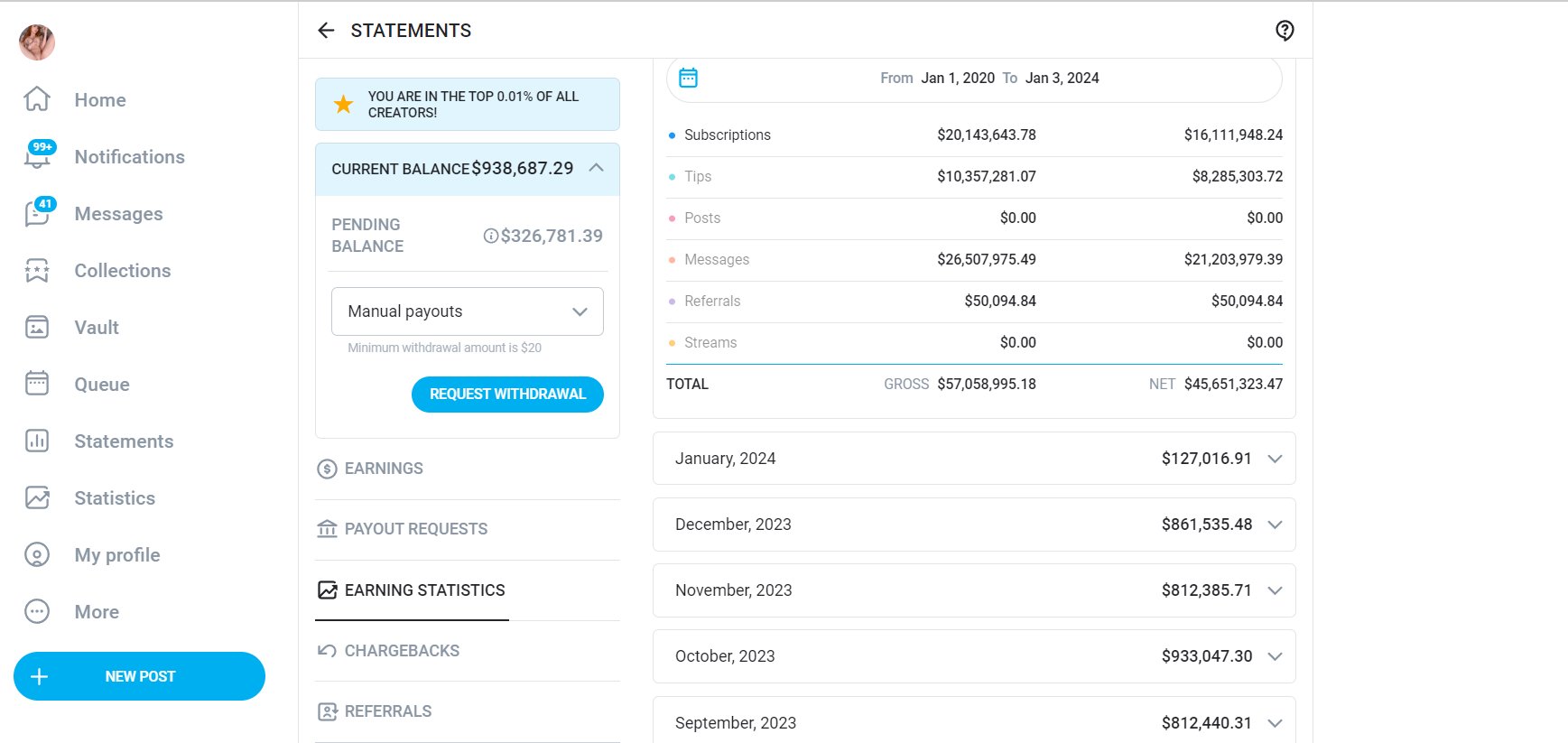
- Cumulative to mid-2022: roughly $33.8M gross / $27M net on OF.
- Cumulative to Jan 2024: about $57.06M gross / $45.65M net.
- Revenue mix: subscriptions passed $20M, tips topped $10M, and messages (PPV/DM) delivered roughly $26.5M—meaning pay-per-view out-earned subscriptions.
Here’s how that math actually works at scale:
- Subscriptions set the floor. They stabilize cash flow and predict churn, but they don’t explain seven-figure months.
- PPV/DM is the engine. Custom requests, locked galleries, limited-time bundles, and seasonal drops raise ARPPU well beyond what a flat sub can do. The top 1–5% of spenders (“whales”) stretch the ceiling.
- Tips smooth volatility. Spikes from headlines or returns after suspensions convert into tips fast; they’re impulse-friendly and margin-rich.
- Twitch is acquisition, not profit. When ads were pulled, the platform’s fragility was obvious. Treat it as a paid billboard; don’t rely on it for yield.
Operationally, the cadence looks like a proper direct-to-consumer shop: multiple daily posts, scheduled DM campaigns, fast response times, and clear upsell ladders (sub → PPV set → custom → VIP). With assistants and templates, throughput rises without burning the persona.
My professional read: this is a hybrid subscription + transactional media business. The subscription buys permission; the transaction captures value. Controversy on stream isn’t the product—it’s demand generation. The product is high-margin, repeatable PPV that monetizes that demand on her terms.
Pivot to More Explicit Platforms — Chaturbate and Fansly
I watched her shift part of the operation to Chaturbate and Fansly for one simple reason: Twitch throttles and demonetizes the edgier formats that drive her demand, while those platforms allow them under clear rules. There she earns directly from fans—subscriptions, PPV/DM, tips—with predictable payouts and a much higher return per user than ad-supported streaming can offer. In practice she moved the spicier formats where they’re actually permitted and ran a clean funnel: attention on Twitch and socials, conversion on Fansly/Chaturbate, then upsell from subs to PPV to VIP. The reputational effect was immediate—more controversy, routinely framed as “borderline porn”—but that noise feeds discovery, and discovery converts. My assessment: this was a deliberate channel shift to monetize the edge with fewer platform risks and more controllable economics.
Resonance and Backlash — Fan Euphoria and Hater Attacks
I gauge the reaction in two streams. Fans celebrate the execution: they see ruthless consistency, smart funnel design, and a creator who owns her pricing instead of chasing ad budgets. They call it empowerment, not provocation—proof that a personality-led brand can turn attention into a product without asking a platform or a sponsor for permission. They also point to the work ethic: long live shows, relentless posting, fast DMs, and tailored PPV that actually delivers what the audience pays for. In their eyes, the controversy is a feature, not a flaw—it keeps the spotlight hot and the offers moving.
Critics come from the opposite angle. They argue she’s “pornifying” streaming, normalizing softcore aesthetics on platforms built for general audiences, and gaming policy edges to manufacture headlines. They call the parasocial layer manipulative, claim the content blurs lines for younger viewers, and warn brands that the association risk outweighs the reach. Some frame it as exploitation wrapped in “entrepreneurship,” others as a cynical loop: provoke, get punished, return bigger, repeat.
My assessment is straightforward. The fans are reacting to product-market fit and ownership; the haters are reacting to boundary costs and optics. Both are right in their lanes. The strategy works because the upside (direct revenue, pricing power, predictable payouts) is captured on paywalled platforms, while the downside (PR noise, policy friction) lives on open platforms where attention is cheap. As long as that trade holds, the euphoria and the attacks are two sides of the same engine—and she’s driving it.
Amouranth: Walking the Line with the Porn Industry
Why She Didn’t Become an “Official” Porn Actress — Balancing What’s Allowed and Off-Limits
I separate her options into three lanes: platform-safe erotica, paywalled explicit content, and studio porn. She plays the first two and deliberately avoids the third.
I read that as a control and margin decision. Studio contracts dilute ownership, lock you into someone else’s schedule, and cap upside. On her own paywalls she prices, packages, and times releases, keeping far more of each dollar and targeting high-spend fans through PPV and DMs.
Distribution matters. Studio scenes leak everywhere and cannibalize sales. Her model funnels curiosity into subscriptions, then into transactions; the unit economics are better when she owns the channel.
Access matters too. Going full studio porn would close doors on mainstream reach—Twitch, YouTube, certain sponsors, even some payment rails. Staying just this side of the line preserves the top of the funnel while monetizing the edge elsewhere.
There’s also brand positioning. The tension—“on the edge, not over it”—is part of the appeal. Cross the line and the story flattens; the audience narrows. By keeping control of sets, partners, and boundaries, she also reduces safety and reputational risks.
My bottom line: this isn’t prudishness; it’s strategy. Avoiding “official” porn maximizes attention and revenue while preserving distribution, optionality, and leverage.
How OnlyFans Leaks Made Her Even More Popular
I treat leaks as involuntary top-of-funnel. When sets spill onto tube sites and forums, reach explodes past the paywall at zero cost to her. You lose some exclusivity on a given drop, but you gain mass awareness among people who would never touch a paid link without a free sample.
The conversion path is predictable: viewers see a leaked clip, search her name, land on official pages, and subscribe for what piracy can’t deliver—recency, full quality, two-way interaction, and custom PPV in DMs. Every major leak wave is followed by a spike in traffic, subs, and paid messages within the next 24–72 hours. That pattern repeats because the product she sells isn’t just files; it’s access.
Takedowns help but aren’t the objective. You file DMCAs to the biggest hosts, watermark content, and stagger releases, but you accept that removal will be partial. The real play is to redirect attention with clear calls to action, bonus packs for official subs, and high-value material that lives behind messages where piracy has less leverage.
My read: leaks dent per-asset revenue, but they fuel demand and brand gravity. In this model, they function as negative-cost marketing—pirates pay for distribution, she captures the upside with a paywall that sells immediacy, interaction, and scarcity that leaks can’t replicate.
Media Impact — From Tabloids to Memes
I treat her publicity as an earned-media machine. Tabloid headlines land first, then tech and culture outlets repackage the story, and reaction channels multiply it across YouTube and TikTok. Each wave drives searches for her name, fresh follows, and traffic into the paywalled funnel.
Memes keep the cycle alive after the news fades. Screenshots, short clips, and quotable one-liners turn into templates that resurface with every new incident. That repetition cements recall and lowers the cost of the next promotion—audiences already know the punchlines.
The polarity is the point. Positive coverage frames her as a savvy operator; negative coverage frames her as a rule-breaker. Both create attention, and attention is the top-of-funnel input. I measure success not by sentiment but by movement: more branded searches, more profile visits, more conversions.
My take: the media doesn’t just report on her—it extends the product. Headlines generate discovery, memes generate persistence, and together they deliver a compounding edge that paid ads can’t match.
Casino Deals and Platform Contracts — The Amouranth Kick Connection
When people talk about big-money streaming contracts, they love to throw Amouranth’s name into the same sentence as Stake.com. And while the fantasy version makes for great headlines — “streamer signs multi-million casino deal” — the reality is more calculated, but no less controversial.
In June 2023, Amouranth didn’t ink a deal directly with Stake. She signed with Kick — a platform bankrolled by Stake’s co-founders. On paper, it was a non-exclusive streaming agreement, allowing her to keep her Twitch audience while testing the waters on a site that was openly pushing gambling streams as a growth engine. She never disclosed the payout, but she did admit one thing: her income doubled almost instantly.
That’s where the speculation started. Kick wasn’t shy about courting gambling viewers — its “Slots & Casino” category was a money magnet. And in the wider streaming world, some creators did get direct Stake contracts alongside their Kick deals. It wasn’t a leap for critics to assume Amouranth was part of that same casino marketing machine. But here’s the twist: there’s no public, verifiable record of her having a separate Stake contract. That hasn’t stopped the narrative from sticking — because in this business, perception is just as powerful as proof.
Kick itself became a lightning rod. With its deep pockets and gambling-funded war chest, it signed headline-grabbing names, paid hourly rates to streamers in casino categories, and openly challenged Twitch’s moral stance on gambling content. Two years later, the tide shifted. Kick cut back on the mega-contracts and killed hourly payouts for gambling streams, trying to rebrand away from the “Stake.com with chat” image.
For Amouranth, though, the connection was already cemented in the public’s mind. Whether she was an actual casino brand ambassador or just a highly paid passenger on the same money train, the optics were the same: she became the face of a platform built on gambling revenue. And in an industry obsessed with controversy, that label is worth its weight in clicks.
Amouranth’s Business Empire
I track her off-stream portfolio across three buckets: operating assets, land, and liquid risk—and the purchase math is straightforward.
Gas stations / convenience real estate.
She started with a Circle K for about $4,000,000 in late 2021 (roughly $1M down, the rest financed). The appeal was classic: stable cash flow, leverage, and bonus depreciation that improves after-tax yield. Soon after, she joined a syndicate on a 7-Eleven deal around $10,000,000, taking roughly a quarter stake rather than 100% ownership. In 2022 she added another site: a 7-Eleven with an attached rollover car wash for about $8,300,000 (roughly 1.5 acres, full C-store plus fueling). Operationally this isn’t glamour—it’s throughput, margins on fuel and retail, car-wash add-ons, and tax shields that compound returns.
Agricultural land (orchards).
In November 2023 she bought four citrus orchard sites totaling 2,213 acres across Florida and neighboring states for $17,000,000, with an option for another 928 acres at ~$7,200,000. Primary crop: Valencia oranges sold into juice processors. The thesis is duration: scarce land, inflation linkage, professional operators on the ground, and the ability to bank acreage while headline drama plays out elsewhere. It diversifies both revenue and reputation—when the timeline argues about hot-tub streams, the trees are still throwing off yield.
Crypto treasury.
By late 2024 she held ≈211 BTC—just over $20M at the time. That’s high-beta exposure: great narrative upside, meaningful operational risk. After the 2025 home-invasion incident aimed at her crypto, the only rational move was tighter custody, redundancy, and quieter wallets while keeping the asymmetric upside in place.
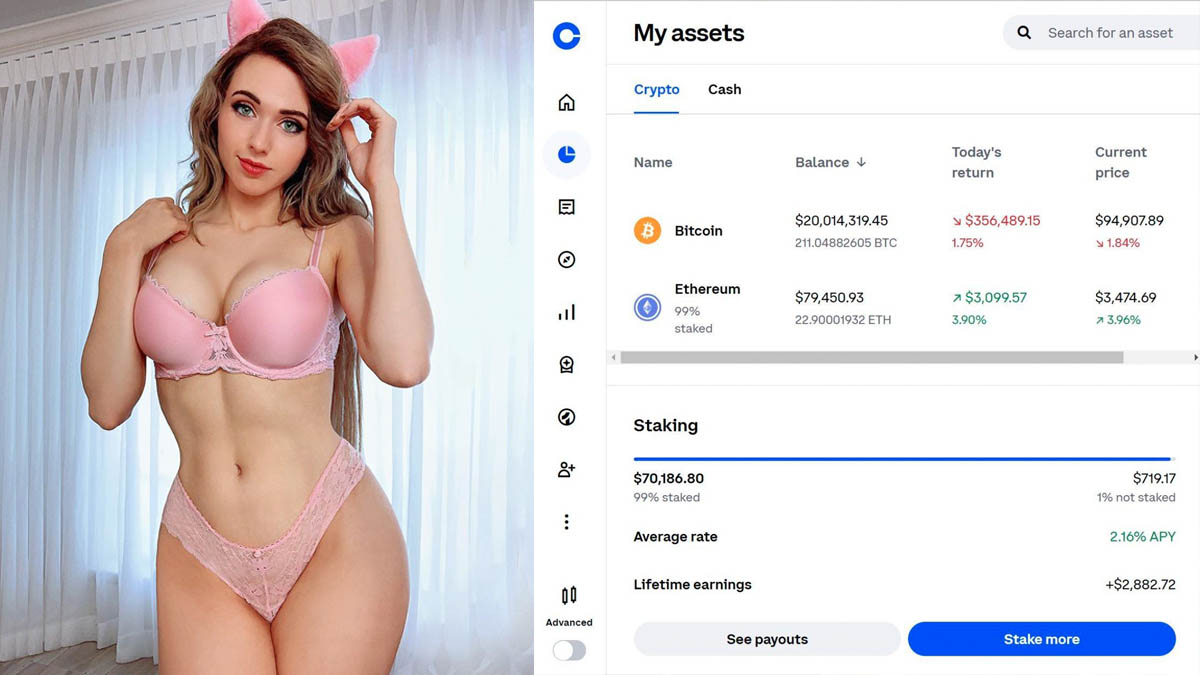
My read.
This isn’t a novelty shopping spree; it’s a barbell. Cash-yielding, depreciable real assets on one side; long-duration land on the other; liquid asymmetric bets in the middle. Attention funds acquisitions, acquisitions harden the balance sheet, and that balance sheet buys the right to take louder swings when the next cycle of controversy pumps the funnel again.
Scandals and Money — The Success Formula
I don’t romanticize her rise; I model it. The engine is simple: create controversy on open platforms where reach is cheap, let tabloids and reaction channels amplify it, then capture the surge behind a paywall where pricing is under her control. Twitch, Kick, and short-form are discovery; OnlyFans, Fansly, and cam platforms are the checkout. The product isn’t the drama itself—it’s high-margin PPV and DMs that monetize the attention the drama generates.
The mechanics are repeatable. Boundary-pushing formats trigger moderation and headlines; headlines spike searches; searches flow into subs; subs upsell to PPV, customs, and VIP. Leaks act as forced sampling that widens the funnel; takedowns recapture a slice, but the real win is converting curious viewers with fresher, higher-quality, interactive content they can’t pirate. When ad policies wobble, she shifts the edgiest formats to adult-native platforms with clearer rules and steadier payouts, keeping the top of the funnel intact while maximizing yield at the bottom.
Cash flow doesn’t sit idle. She rolls profits into offline assets—gas/convenience real estate and orchards—for stability, depreciation, and duration, while keeping liquid upside in crypto. That barbell—volatile attention on one side, steady cash and land on the other—makes the business resilient to algorithm changes, ad freezes, and platform risk.
The results justify the design. By early 2024, OnlyFans alone had delivered roughly \$57M gross / \$46M net, with peak months around \$1.5M. Add years of Twitch/Kick, other adult paywalls, and sponsors, and lifetime gross comfortably clears \$70M, with net above \$50M pre-tax. On a current basis, the online run rate sits near \$12–20M/year, while offline holdings add another ~\$2–3M/year in operating cash.
Conclusion
I don’t see luck here; I see a system. She manufactures attention on open platforms, converts it behind a paywall, and fortifies the profits with offline assets. The “on the edge, not over it” stance keeps reach maximal without collapsing distribution. Leaks, bans, and headlines aren’t setbacks—they’re inputs that feed the funnel. The outcome is a repeatable controversy-to-cash loop with seven-figure months online and steady offline yield. That’s the model—and it’s built to outlast algorithms, ad freezes, and platform swings.